
The oak at Brackley Manor

12/11/2025
- Horror Writing
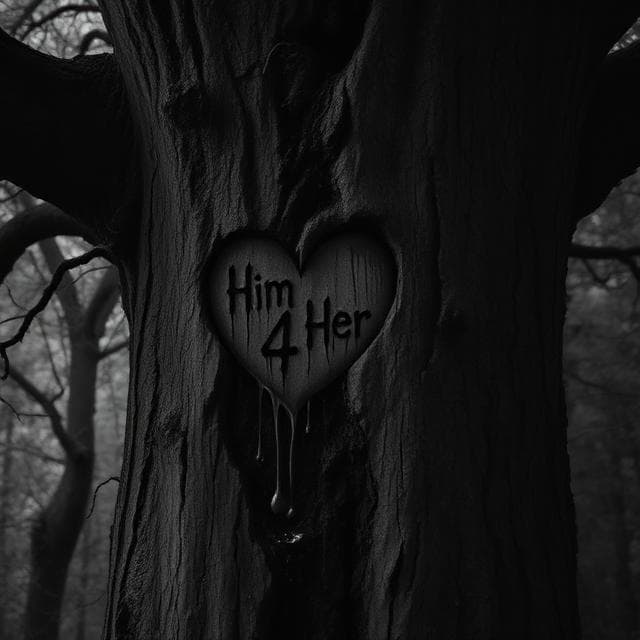
They said the oak was cursed.
No one could quite remember when the whispers began — only that by the time anyone took them seriously, it was already far too late.
The oak stood on the edge of the Brackley estate, a hulking silhouette against the sky. Its bark was thick and ridged, its branches clawing upward like bones breaking through the soil. For generations, couples had carved their devotion into its trunk, believing the act would bind them forever. It did — though not in the way they imagined.
The first couple were found in their car at the edge of town.
Their throats torn open — jagged, uneven —
as though the killer’s hands had shaken with rage.
The second pair were cleaner, almost ritualistic.
By the fourth, they weren’t cut at all. They were found in their home, sitting upright on the sofa, hands clasped, their faces twisted into identical smiles — bark fragments lodged beneath their fingernails.
Someone — or something — was learning.
It was a weary constable who spotted the link: every one of the victims had visited Brackley Manor days before their deaths. Every one of them had carved their names into that same ancient oak.
Attempts to understand the curse led back to the manor’s beginnings. The estate had belonged to Lord Brackley, a magnate of the Industrial Age whose wealth was as infamous as his cruelty. When he died, his family planted the oak in his memory — soil from his grave said to have been mixed into its roots. Over time, the Brackley fortune dwindled, and the manor was sold to the National Trust. Only one man remained from the old days: the groundsman, Henry.
He was a gruff old soul, rarely spoke, and never smiled.
Villagers said he talked to himself as he worked. Some claimed he avoided the oak altogether. Others swore they’d seen him standing before it in silence, as if listening.
The next bodies were found hanging from a tree far from the manor, faces marked with the same cruel initials they had once carved in play. That was when the oak was finally cordoned off. Yet fear breeds fascination. The curious still came — whispering, daring, touching the bark as though to test its hunger.
The public demanded the oak be felled, but superstition triumphed over sense. No one wished to be the one to strike the first blow.
A tabloid headline made light of the whole affair: “A Bite Worse Than Its Bark.”
Years passed. The story faded. The oak stood in silence, waiting.
Then came the jilted lover. He carved his rival’s name into the bark one mist-soaked evening, laughing to himself as the blade bit deep. Two weeks later, he was found sprawled in his flat, chest opened wide, his heart missing. The rival lived on, none the wiser.
The oak slept again.
Until one cold, windless night, Henry was seen walking toward it, a lantern in one hand, a small knife in the other. He moved slowly, as if drawn by something unseen. He stepped over the broken cordon, stopped beneath the oak’s heavy branches, and began to carve.
What he wrote, no one saw.
By morning, he was dead, found in his cottage bathtub, wrists slit, the water the colour of rust. The police called it suicide.
But one old officer,
haunted by memory,
walked the path to the oak before leaving.
And there — beneath the rough bark —
a fresh carving gleamed pale in the dawn light.
HENRY BRACKLEY.